
 |
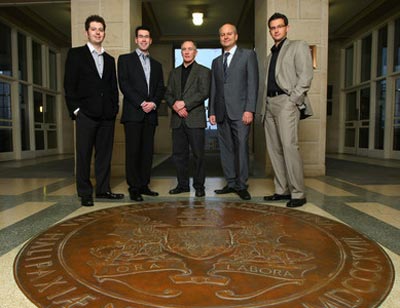
| MBA students Zach Silbernagel and Christopher Humphries and their professor David Roach were recruited to work on��marketing the��medical device developed by Michael Schmidt and grad student Florentin Wilfart.��(Nick Pearce Photo) |
It���s called post-operative cognitive decline, a syndrome in which patients experience memory loss or other forms of cognitive dysfunction after surgery or critical illness.
���We see it more and more among elderly patients because these people have less reserve to compensate for side effects of surgery and anaesthesia,��� says Michael Schmidt, Dalhousie professor of Anaesthesiology, Physiology, Neurosurgery and Biomedical Engineering.
���Post-operative cognitive decline���POCD���affects the brain, specifically memory and span of concentration,��� continues Dr. Schmidt. ���It causes a lot of grief for patients and their families and there���s an enormous cost in dealing with the side effects.���
Prototype developed
Concerned about what he sees as a growing problem, Dr. Schmidt started research in the field of cerebral and organ protection resulting in innovative anaesthesia procedures and devices.�� In the process, he relocated to 窪蹋勛圖 from Germany to continue this research and to facilitate the development of�� prototypes. As one project he invented a new device for the removal of carbon dioxide in the anaesthesia circuit to make anaesthesia safer.
Dr. Schmidt was later joined by grad student Florentin Wilfart, who took on the fine-tuning of the prototype for his PhD with the School of Biomedical Engineering.
With a prototype developed, Dr. Schmidt and Mr. Wilfart reached out to David Roach, assistant professor with the School of Business Administration, and MBA students Zach Silbernagel and Christopher Humphries for help with the next step���to bring their research that much closer to helping patients and their families.
Collaboration
���For me, it���s not enough to get your research published,��� says Dr. Schmidt. ���You must be thinking of getting that research to the patient in a very efficient way.���
Last month at the Apex Business Plan Competition at the University of New Brunswick, the interdisciplinary team presented a business plan for the medical device to a panel of judges���and won. ���It does bode well for getting the device to market,��� says Mr. Humphries.
The hope is to bring the device from ���bench to bedside��� by 2014, but first more research has to be done, clinical trials conducted and a regulatory process to undergo.
In the meantime, Dr. Roach is pleased with the way the team has come together and learned from each other���s strengths. ���A collaboration like this gives rich and deep experience to the students who stepped up to the plate.���
On the horizon is another prestigious competition. The team is one of 12 across the country selected for the 2011 IBK Capital-Ivey Business Plan Competition to be held January 28 and 29 at the Richard Ivey School of Business in London, Ont.
LINK: